

Featured Image

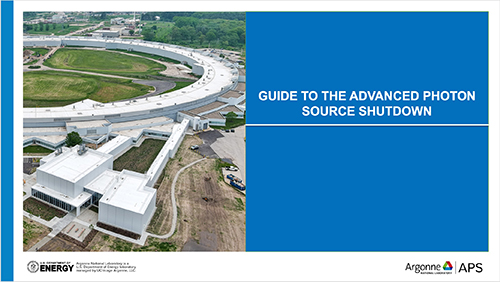
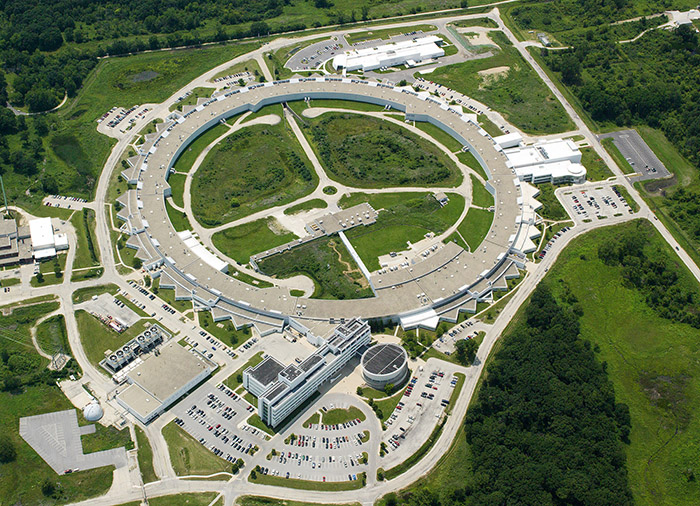
The Advanced Photon Source (APS) at Argonne National Laboratory is a national synchrotron x-ray research facility funded by the U.S. Department of Energy, Office of Science, Office of Basic Energy Sciences. The APS provides the brightest x-ray beams in the Western Hemisphere to more than 5,000 scientists worldwide.

  • Learn: about x-ray research
  • Start: become an APS user
  • Work: resources for users

RSS feed APS Today

RSS feed Science & Research Highlights

An X-ray Vortex on the Horizon?

MAY 5, 2008

Argonne physicists have shown theoretically that the harmonics of the x-ray radiation from a helical undulator have the twisted-phase front and singular core characteristic of an optical vortex, a tornado-like state of light that carries orbital angular momentum. An "x-ray vortex" beam has the capability to make tiny particles swirl in its field and may be useful for the exploration of previously inaccessible quadrupole and other electronic transitions. Until now, production of x-ray vortices has required inefficient optics that must be tuned to the x-ray beam energy.


A Protein that Repairs Damage to Cancer Cells

MAY 5, 2008

University of Chicago scientists using two x-ray beamlines at the Argonne Advanced Photon Source have shown how a protein detects and repairs damage in human cells; the study raises the possibility of designing a molecule that could interfere with the repair process, making a certain type of cancer treatment more effective.


Scientists Discover How Nanocluster Contaminants Increase Risk of Spreading

APRIL 24, 2008

Scientists have known that nanometer-size clusters of plutonium oxide are responsible for plutonium contamination spreading further in groundwater than expected, increasing the risk of sickness in humans and animals. But the nature of the clusters remained a mystery until researchers using x-ray beams from the Argonne Advanced Photon Source were able to solve the structure of the clusters and begin to unlock their secrets.


How Two Drops Become One

APRIL 24, 2008

Scientists from Argonne National Laboratory, using an x-ray beamline at the Argonne Advanced Photon Source, have found a window into the process of water drop coalescence, employing ultrafast pulses of full-spectrum, high-intensity x-rays to capture with unprecedented clarity and definition the moment of two water droplets becoming one.


Mobile RNA is Poised and Ready

APRIL 10, 2008

Research at two Advanced Photon Source x-ray beamlines has produced a new picture of a genetic parasite isolated from a deep-sea bacterium that is helping researchers see how certain specialized segments of RNA escape from their positions in the genome and invade new RNA or DNA. The mobility of these genetic elements has had a profound influence on evolution, promoting diversity among the world's most ancient organisms.


Glass Does a Double-Take

APRIL 4, 2008

How and why glass forms remains a scientific mystery. But experiments by scientists from Yale University and Argonne using the Advanced Photon Source have shown that, sometimes, heating a liquid can also turn it into a glass. By confirming predictions from recent theories about the transition of liquids to glass, their work might make glass a bit less mysterious.


Welcoming a New Family of Superconductors

APRIL 3, 2008

A new family of superconductors has been discovered by an international research team using the Argonne Advanced Photon Source. This research could eventually lead to the design of better superconducting materials for a wide variety of industrial uses.


RSS feed Featured News

A Marriage of Hardware and Hard Work

MAY 5, 2008

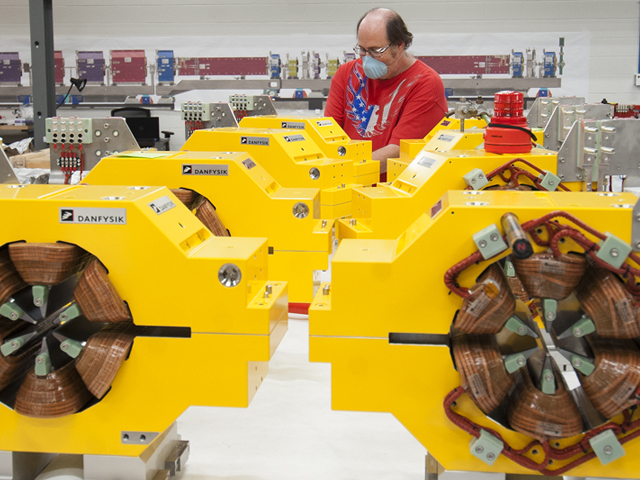
The first of 33 Linac Coherent Light Source undulator support girder assemblies [designed at the Argonne Advanced Photon Source] has been readied for final alignment at the Stanford Linear Accelerator Center.


Shaken but Not Stirred

APRIL 28, 2008

The earthquake that occurred in Illinois’ Wabash Valley fault system on Friday, April 18, could have caused a fault of different kind — a system fault that could have interrupted delivery of high-brightness x-ray beams to researchers using the Argonne Advanced Photon Source (APS). But thanks to the sophisticated technology in use at the APS — much of it developed at Argonne — experimenters who were taking data at the APS when the earthquake occurred at 4:36 a.m. (DST) were able to continue their research uninterrupted.


2008 Rosalind Franklin Young Investigator Award

APRIL 24, 2008

The Advanced Photon Source Users Organization has named Oleg G. Shpyrko, of the University of California, San Diego, as the recipient of the 2008 Rosalind Franklin Young Investigator Award, which recognizes an important technical or scientific accomplishment by a young investigator that depended on, or is beneficial to, the APS. Shpyrko will receive the award on May 5 at the 2008 Users Week at Argonne National Laboratory, where he will also present his work.


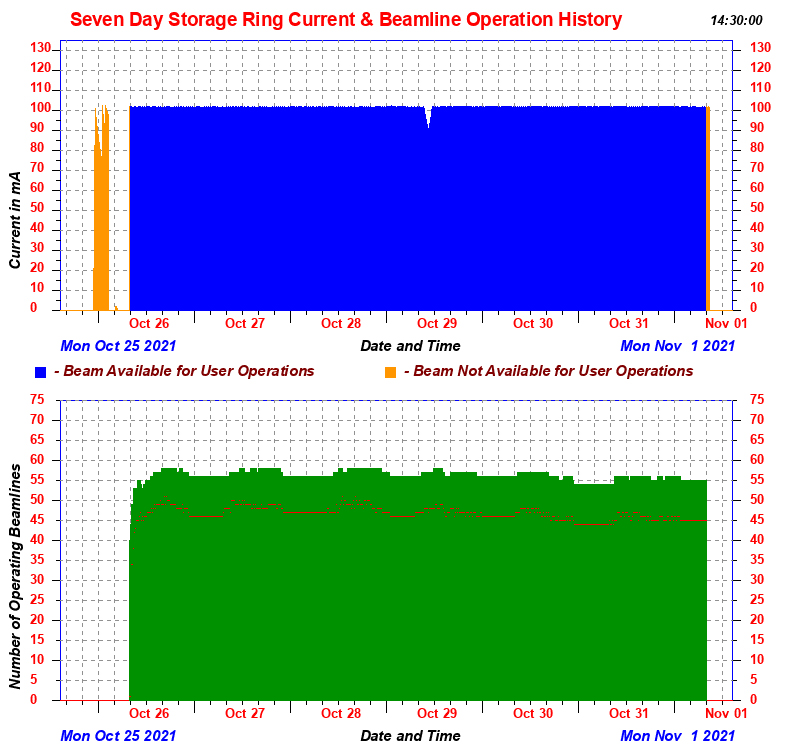
Beam and Ring Status

Click an image to magnify.

Annual Report

Annual ReportThe 2007 edition of APS Science (the annual report of the APS) is now available.

APS Upgrade

Introduction to the APS Upgrade
Relevant information, workshop presentations, and comments.